
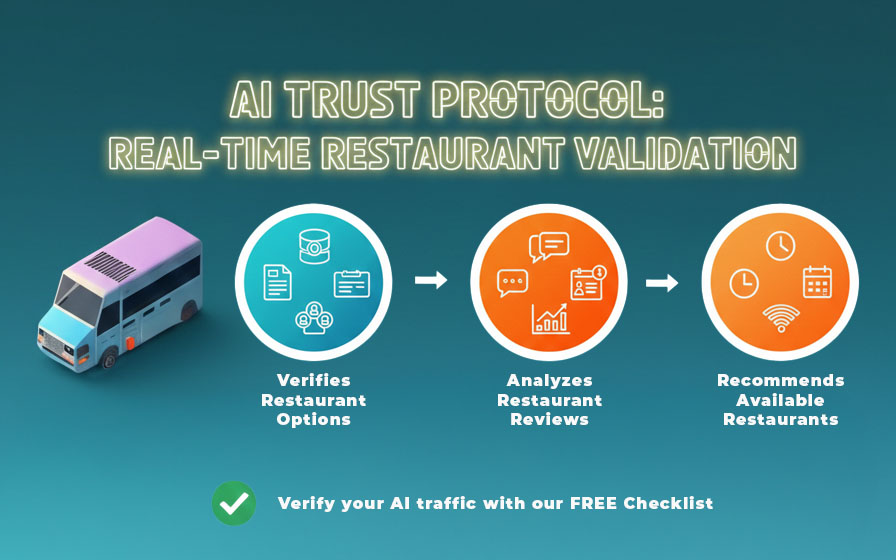
The Bottom Line: AI search engines prioritize Entity-based signals like your real-time reviews, text-based menus, and live wait times — over static SEO keywords to provide users accurate recommendations. By digitizing daily specials and capturing high-frequency "vibe" reviews, restaurants maintain the relevance AI requires to authorize a recommendation. (Scroll for our 2026 Freshness Checklist below).
What You Need to Know:
- Data Freshness is the New SEO: Static keywords are losing ground to live data streams like real-time wait times and inventory updates.
- Kill the PDF: AI models cannot index image-based menus; text-based, structured menus are mandatory for conversational search discovery.
- The Vibe-Check Economy: AI filters for sensory data (e.g., "dim lighting," "quiet for dates") within recent reviews to determine your restaurant's recommendability.
Why Does AI Crave "Fresh" Content?
Traditional search engines were libraries, and their custodians like Google filed information away. Modern AI engines are Real-Time Analysts. They don’t just want to know you serve "Italian food" — they want to know if you have a table available right now and if your "truffle pasta" is still getting rave reviews this week. If your digital presence hasn't moved in six months, an AI agent assumes your business is either closed or irrelevant.
The "Fresh-First" Implementation Strategy
1. Use Reviews as a "Vibe" Training Set
AI doesn’t just count stars; it scans for sensory entities. If five reviewers this week mention your "dim lighting" and "hand-crafted cocktails," AI categorizes you as a "Top Date Spot."
-
The Action: Incentivize servers to ask for reviews that mention specific new dishes or the atmosphere. This "trains" the AI to recommend you for specific moods.
2. Transition from "Images" to "Entities"
A photo of a chalkboard menu is a dead end for a crawler. To an AI, a PDF is a locked door.
-
The Action: Move your menu to a text-based, structured format on your site and Google Business Profile. When you update your "Daily Catch" in text, the AI indexes that change instantly, making you the top answer for "fresh seafood today."
3. Synchronize Your Digital "Pulse"
AI agents are now facilitating orders and reservations directly. If an AI recommends your "Famous Ribs" but they are 86'd on your POS, the AI learns that your data is unreliable and will stop recommending you.
-
The Action: Sync your POS inventory with your discovery platforms. Operational fluidity is now a ranking factor.
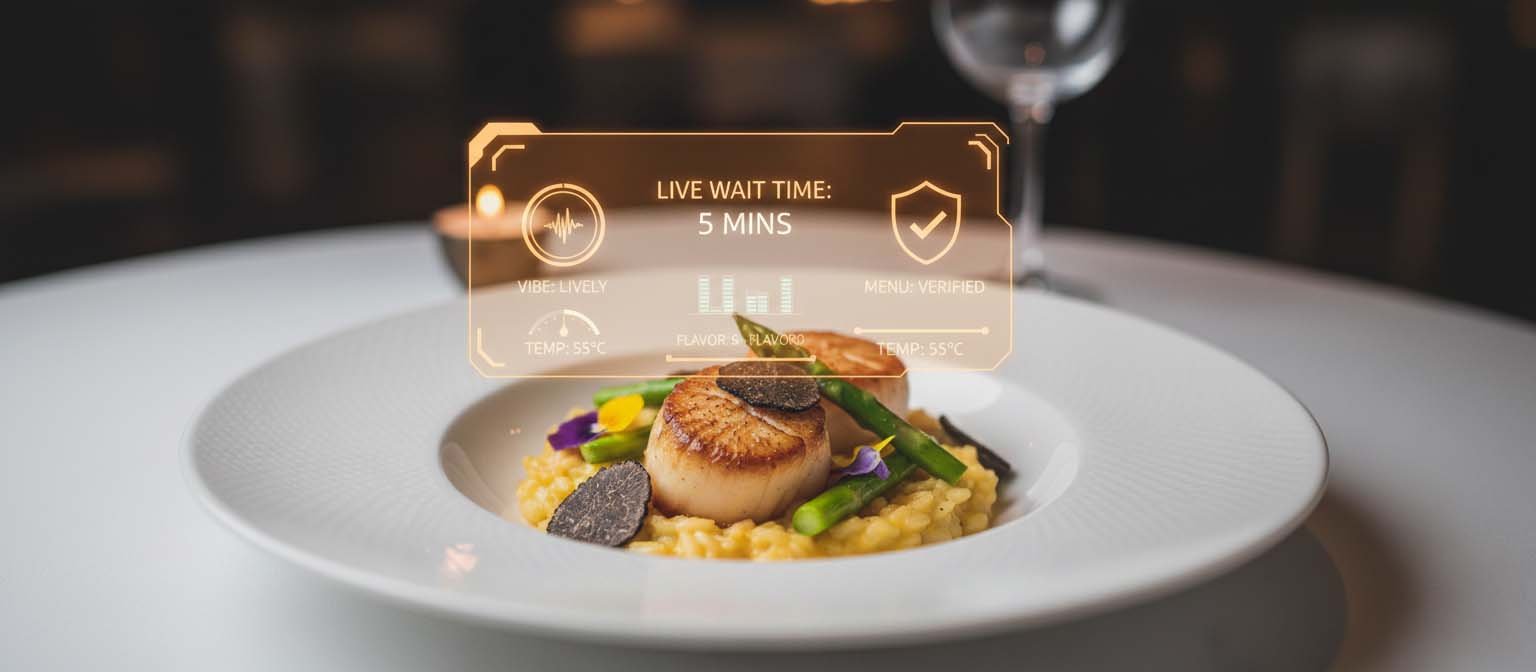
The Anatomy of an AI-Driven Recommendation
To understand why freshness matters, whether its content or signals, you have to understand the Discovery Loop. When a user asks an AI agent, "Find me a lively spot for drinks tonight around 8PM," the AI performs a three-step validation:
1. Entity Confirmation:
Does this restaurant exist and is it open? (Checked via Google/Apple Maps). Before an AI can recommend you, it must verify your physical existence and operational status. It cross-references multiple data points to ensure it won’t send a human to a locked door. If your hours on Apple Maps don't match your Google Business Profile, the AI perceives a "Data Conflict" and lowers your trust score.
-
Coordinate Consistency: AI checks if your GPS coordinates match across all major directories to verify you aren't a "ghost kitchen."
- The "Holiday" Factor: AI prioritizes restaurants that have explicitly confirmed their hours for upcoming holidays or special events within the last 30 days.
- Operational Metadata: Beyond just "Open/Closed," AI looks for "Service Status" is the kitchen open late, or is it bar service only?
2. Sentiment Analysis:
Is it actually 'lively'? (Checked via reviews from the last 14 days). Traditional SEO relied on star ratings; AI SEO relies on Natural Language Processing (NLP). The AI reads the subtext of reviews from the last 14 days to see if your current reality matches the user's specific intent. If a user asks for a "lively" spot, the AI looks for recent linguistic clusters around noise, energy, and crowds.
-
The 14-Day Recency Bias: Reviews older than two weeks are weighted significantly less because "vibe" is considered a perishable commodity.
- Descriptor Extraction: The AI extracts sensory adjectives (e.g., "thumping bass," "packed bar," "energetic servers") to build a real-time mood profile of your room.
- Sentiment Trendlines: If recent reviews mention "slow service" or "ran out of the special," the AI will de-prioritize the recommendation, even if your overall rating is 4.8 stars. Responding to reviews helps with local restaurant marketing, and helps AI with signals that your business is responsive to customers.
3. Availability Verification:
Can the user actually get a drink? (Checked via live menu data and reservation API). This is the final and most critical stage. The AI agent wants to facilitate a transaction. If it cannot confirm that the user can actually get what they want (a seat or a specific drink), it will choose a competitor with an open API or a transparent digital inventory.
-
API Interrogation: The AI pings Yelp, Google and reservation platforms (OpenTable, Resy) in real-time. If no table is available, you are filtered out of the "Recommendation Set."
- Menu Item Persistence: For specific queries (e.g., "Who has a great mezcal negroni?"), the AI scans text-based menus. If that item hasn't been "seen" by the crawler in months, the AI considers it "unverified."
- The "86" Signal: Future-forward POS integrations allow AI to see when a high-demand item is out of stock, preventing the "bad experience" of a customer arriving for a dish that isn't there.
Feed the Algorithm, Feed the Guest
The era of "set it and forget it" restaurant websites is over. To win in 2026 and beyond, your restaurant must be a living digital entity. If you don't feed the algorithm fresh data, the algorithm won't feed you customers.
Don't leave your business growth to chance. Book a FREE Restaurant Marketing Consultation today to audit your POS integrations, pixel tracking, and AI-readiness.